Odin Rising: The Anvil Battlecruiser and the End of an Era
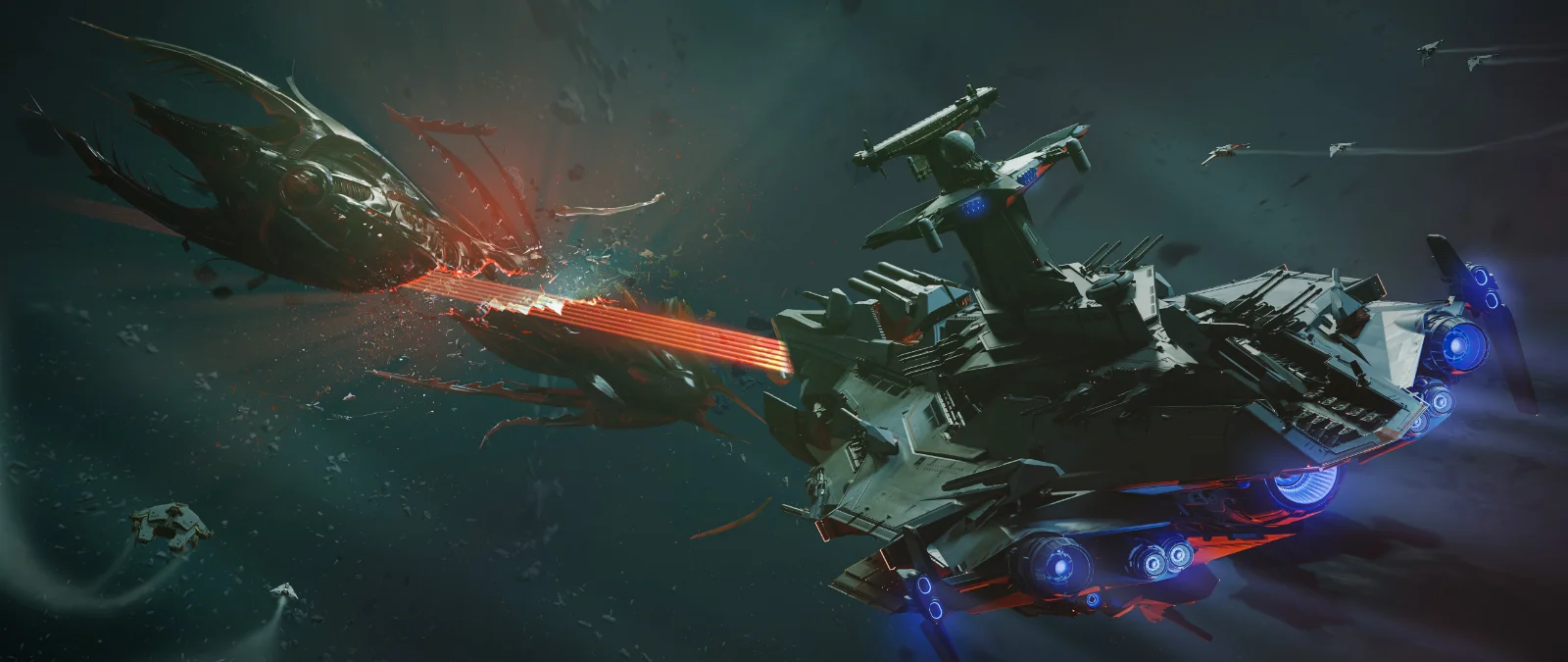
Everything about the Anvil Odin battlecruiser — specs, armament, crew requirements, Founders Club sale, and what this 752m capital ship means for Star Citizen…
There are moments in the verse when the scale of human ambition becomes impossible to ignore.
Not the quiet hum of a starter ship leaving Port Olisar. Not the distant flash of a dogfight over a moon. Something heavier. Something that casts a shadow long enough to swallow a city block — and then keeps going.
At DefenseCon 2956, Cloud Imperium Games pulled back the curtain on exactly that kind of presence: the Anvil Odin, a battlecruiser so vast it reads less like a ship and more like a moving sovereign state drifting through the black.
Seven hundred and fifty-two meters of hull. Two hundred and twenty-two meters of wingspan. Two hundred and thirteen meters from keel to crown. Numbers on a spec sheet, until you see it hanging over Area 18 on ArcCorp — a silhouette against the neon haze, silent and patient, like something that has always been there and is only now choosing to be seen.
This is not a fighter. This is not a freighter with guns bolted on for show.
This is the end of a long road.
The Last Ship From the Old Dream For veterans of the project, the Odin carries weight beyond its mass.
CIG has confirmed it as the final concept ship tied to the original crowdfunding stretch goals — the last vessel from the earliest blueprint of what Star Citizen was supposed to become. After more than a decade of building toward “the biggest space sim ever made,” the Odin is the closing bracket on that first chapter.
What comes next is implementation, polish, Squadron 42, server meshing, StarEngine refinement. But this ship? This is the last ghost from the founding vision, finally given form.
That alone makes it historic. Everything else is just… astronomical.
A City That Fires Back The Odin is planned as the second-largest flyable ship in Star Citizen, dwarfed only by the legendary Bengal carrier. In practical terms, it is a capital warship built for organizations that think in fleets, not solo runs.
The bones:
Manufacturer: Anvil Aerospace Class: Battlecruiser Length: 752m Minimum crew: 33 (turrets operational) Optimal crew: 65+ Cargo: 8,000 SCU (6,000 main hold + 2,000 cargo lift) Inside that frame, CIG has hinted at something stranger than a warship: fighter wings, internal transit systems, even chamber spaces evocative of a parliament. The Odin is not merely armed. It is inhabited — a vessel meant to be lived in, commanded from, argued over, and fought from across dozens of stations and roles.
For org leaders, that is the real headline. The Odin is not a trophy. It is a coordination problem wrapped in armor.
Teeth of the Void Armament is where the Odin stops being impressive and starts being terrifying.
Reports from the reveal point to triple Size 12 cannons, a frontal beam weapon spanning the entire bow, and 20 torpedo launch tubes — capital-grade firepower designed to dominate engagements where Idris-class ships currently hold the line. This is the ship meant to sit between destroyer and carrier in the fleet hierarchy: heavy enough to anchor a battle, mobile enough to press the advantage.
Whether you are running security for a mining op or prosecuting a system-wide campaign, an Odin on your side changes the physics of the fight. The void gets smaller when something that size turns its bow toward you.
Of course — and this matters — the Odin is not flyable yet.
It remains a concept pledge: sold, documented, dreamed about, but still on the slipway. Owners receive loaner ships (including the Aegis Idris-P) until the Odin leaves the shipyard and enters the Persistent Universe for real.
The ship exists in the imagination and in the pledge hangar. The stars are still waiting.
The Founders Club and the Billion-Dollar Threshold The Odin’s sale was never going to be a simple “add to cart” moment.
CIG gated access through the Odin Founders Club — an application process where prospective buyers had to make their case for entry. The sale ran across six waves on May 24–25, 2026, priced at $5,000 warbond or $5,900 store credit, with exclusive Founder paints promised never to return.
That window is closed now. For those who missed it, the player marketplace is the only path forward — and transfers carry their own gravity.
Around this same moment, Star Citizen crossed $1 billion in crowdfunding — a milestone that reframes every debate about scope, timeline, and ambition. The Odin did not single-handedly get the project there, but it is hard to ignore the symbolism: the last concept ship, the highest price tag in the game’s history, and a community still willing to fund the dream of flying something that does not exist yet.
Love it or side-eye it, the Odin is a mirror. It reflects how far this project has come — and how much farther it still has to go.
What This Means for Organizations You do not need an Odin to matter in the verse. Most orgs never will own one, and that is fine.
But the Odin sets the ceiling for what coordinated play can look like:
Fleet command at capital scale — dozens of crew across weapons, engineering, hangar ops, and CIC Logistics at war tempo — 8,000 SCU of internal capacity for sustained operations Diplomacy and presence — a ship large enough to be a political statement before the first shot is fired The ultimate org flex — if your roster can field 65+ active players with discipline, the Odin is the fantasy endpoint For the rest of us, the lesson is simpler: capital ships are org ships. The Odin is the exclamation point on a truth every serious organization already knows — coordination beats credits, communication beats cannons, and the best weapon in the verse is a crew that shows up on time.
Waiting on the Slipway The Anvil Odin hangs in that strange space between promise and patch notes. We have seen the silhouette over ArcCorp. We have read the specs. We have watched the funding ticker climb past numbers that would fund entire AAA studios.
Somewhere in the pipeline, hull plates are being placed. Turret hardpoints tested. Internal tram routes mapped. And across the community, orgs are already asking the question that always follows a capital reveal:
Could we crew one?
Maybe. Maybe not. But the void just got a little more interesting.
The Odin is coming. The only question is whether the verse — and your organization — will be ready when she launches.
Fly safe. Command wisely. The black is wide, and the ships are getting bigger.